
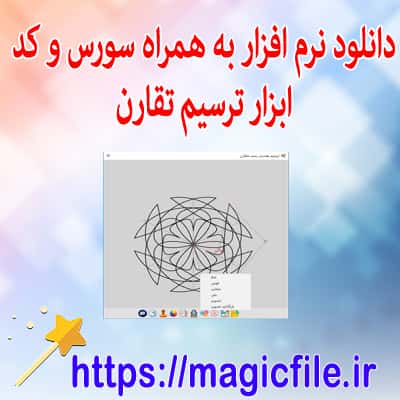
PAINT SYMMETRY: THE ART OF REFLECTION AND BALANCE IN CREATIVE EXPRESSION
In the realm of visual arts, the concept of symmetry holds an esteemed position, acting as a cornerstone for both aesthetic appeal and structural harmony. Among the various forms of symmetry, "Paint Symmetry" or "نقاشی متقارن" exemplifies a fascinating intersection where artistic expression meets mathematical precision, creating works that are not only pleasing to the eye but also rooted in the fundamental principles of balance and proportion. This technique, which involves the deliberate mirroring of shapes, colors, and patterns across a central axis, offers artists a powerful tool to evoke harmony, rhythm, and even a sense of spirituality within their creations.
THE FOUNDATION OF PAINT SYMMETRY
At its core, Paint Symmetry is a process that allows artists to generate perfectly balanced images through the reflection of elements across one or more axes. This can be horizontal, vertical, or even radial. The process begins with a simple sketch or design, which then gets duplicated and flipped across the chosen axis. The result is a composition where each side mirrors the other, producing an effect that is both cohesive and dynamic.
One of the primary reasons artists gravitate toward this technique is its efficiency; symmetry reduces the complexity of designing intricate patterns, making it easier to develop detailed and harmonious artwork. Moreover, when applied skillfully, symmetry can evoke feelings of stability and serenity. Think about the mesmerizing beauty of a butterfly’s wings or the intricate patterns found in Islamic art—these are masterful examples of symmetry’s profound impact.
TECHNOLOGICAL ADVANCEMENTS AND TOOLS
In recent years, the advent of digital painting tools has significantly expanded the possibilities of implementing Paint Symmetry. Software such as Adobe Photoshop, Corel Painter, and even dedicated applications like Procreate offer built-in symmetry tools. These tools allow artists to select a symmetry axis, and then, as they paint, the software automatically mirrors strokes in real-time. This not only accelerates the creative process but also enhances precision, especially for complex designs that would be tedious to replicate manually.
Additionally, some platforms enable multi-axis symmetry, where artists can create radial or rotational patterns, resulting in kaleidoscopic effects. Such features are invaluable for creating mandalas, decorative motifs, or abstract compositions with intricate, repeating patterns—each reflecting a high level of craftsmanship and an understanding of symmetry’s principles.
APPLICATIONS AND VARIATIONS IN PAINT SYMMETRY
Paint Symmetry is far from being a mere decorative technique; it finds applications across diverse artistic domains. For instance, in traditional Islamic art, intricate tile work and calligraphy rely heavily on symmetry to produce mesmerizing, repetitive motifs that symbolize infinity and divine perfection. Similarly, in contemporary digital art, symmetry is often used to create captivating visual effects, logo designs, and even animations.
Furthermore, the technique can be adapted into various styles. Geometric symmetry emphasizes precise, mathematical shapes and lines, often used in modernist works or abstract art. Organic symmetry, on the other hand, mimics natural forms—think of the symmetry seen in leaves, flowers, or animal markings—adding a sense of realism and harmony rooted in nature.
Some artists experiment with asymmetrical symmetry, known as asymmetry or irregular symmetry, where the overall balance is maintained but with deliberate deviations. This approach injects a sense of unpredictability and vitality into the artwork, breaking away from rigid uniformity while still maintaining visual harmony.
PSYCHOLOGICAL AND CULTURAL SIGNIFICANCE
On a psychological level, symmetry in art often evokes feelings of calmness, stability, and order. Humans are naturally attracted to patterns that exhibit symmetry because they mirror the innate desire for balance in life. This phenomenon is observed in the way we perceive faces, landscapes, and even musical compositions. The brain tends to favor symmetrical arrangements because they are easier to process and interpret.
Culturally, symmetry carries symbolic meanings across different societies. For example, in Chinese philosophy, yin and yang embody a balanced duality, often represented through symmetrical forms. In Western architecture and art, symmetry is associated with beauty, perfection, and divine order—think of classical Greek temples or Renaissance paintings. By incorporating symmetry, artists tap into these deep-rooted cultural connotations, thereby enriching their work with layered significance.
CHALLENGES AND LIMITATIONS
Despite its many advantages, Paint Symmetry also presents certain challenges. One common issue is the potential for overuse, which can lead to monotonous or predictable compositions. Excessive reliance on symmetry might suppress creativity or spontaneity, resulting in artwork that feels too rigid or mechanical. Therefore, skilled artists often strike a delicate balance, integrating symmetrical elements with asymmetrical or freeform components to maintain visual interest.
Moreover, achieving perfect symmetry, especially in traditional media, requires meticulous planning and precise execution. Errors in reflection or misalignment can disrupt harmony, making it essential for artists to develop a steady hand and keen eye for detail. Digital tools mitigate this challenge but do not eliminate the need for a thoughtful approach.
THE FUTURE OF PAINT SYMMETRY IN ART
As technology continues to evolve, so too does the potential for innovative applications of Paint Symmetry. Artificial intelligence and machine learning algorithms now assist artists in generating complex symmetrical patterns automatically, opening up new horizons for creative experimentation. Virtual reality environments further allow immersive exploration of symmetrical design, making the process more intuitive and engaging.
Simultaneously, contemporary artists are pushing the boundaries by blending symmetry with other artistic techniques—like fractals, chaos theory, or dynamic motion—resulting in artworks that challenge traditional notions of balance and harmony. This fusion fosters a vibrant dialogue between science, technology, and art, ultimately expanding the creative landscape.
CONCLUSION
Paint Symmetry remains a profound and versatile technique that bridges the gap between mathematical precision and artistic expression. Its ability to produce visually compelling, balanced, and harmonious compositions makes it an enduring element of both traditional and modern art forms. Whether in cultural motifs, digital designs, or abstract explorations, symmetry continues to inspire artists and viewers alike, reminding us of the innate human quest for order, beauty, and meaning within chaos. As technology advances and artistic boundaries expand, the possibilities for exploring symmetry are virtually limitless, promising exciting developments for future generations of creators.